
How Many Pages Are in a Typical Comic Book?

estimated reading time: 4 minutes
How Many Pages Should My Comic Book Have?
If you're planning to print a comic book, one of the first
questions you will likely ask is: How many pages should it have?
While there is no single "correct" page count for your
comic, there are some industry standards and well-established formats. Also, the
binding method dictates how many pages you can include, which in turn impacts
your artwork layout, paper choices, and overall budget.
Drawing from over 40 years of custom printing experience at
Color Vision, here is our guide to standard comic book page counts and what you
need to know before going to press.
The Industry Standard: 24 to 32 Pages
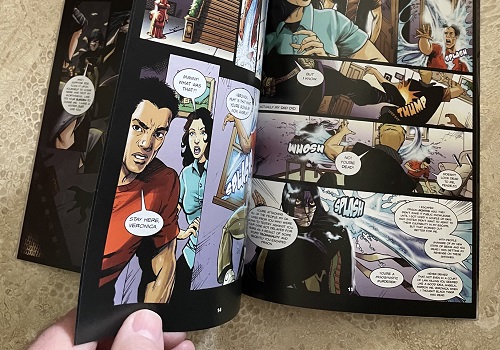
When most people think of a traditional American comic book (often
referred to as a "floppy"), they are picturing a book within the 24-
to 32-page range.
This has been the industry standard for major publishers and
independent creators since the Golden Age of comics. Although some projects
fall outside this range, 24 to 32 pages remains the sweet spot because it
provides enough length to develop a compelling narrative while remaining very
affordable to print.
The Multiples of Four Rule (And Why It Matters)
You may have noticed that the page counts of 24 and 32 are evenly
divisible by four. This is due to the nature of saddle-stitch binding, the most economical, and readily available method for creating comic books.
With saddle-stitching, printed sheets of paper are folded in
half, nested together, and secured together with two wire staples along the spine. Because each
folded sheet (called a "signature") creates four distinct pages, your
total page count must always be a multiple of four. So within the 24- to
32-page range, the available options are 24, 28, and 32 pages.
From Your Bindery Team:
When requesting a comic book quote, it helps to know the terminology used to differentiate a Self-Cover book from a Plus Cover book.
The Self-Cover option uses the exact same paper stock for the cover and interior pages. In this instance, the books would be specified as 24-Page Self-Cover, 32-Page Self-Cover, etc. and then a single type of paper stock would be listed.
The Plus Cover option uses a heavier paper stock for the cover than it does for the interior pages. So the books are specified as 20 Pages + 4-Page Cover or 28 Pages + 4-Page Cover, and then the paper stocks for the interior pages and the cover are listed separately.The Self-Cover option is a fairly popular choice for saddle-stitched comics. About 60% of the saddle-stitched comics we print at Color Vision are Self-Cover. As far as perfect bound comics and graphic novels go, the Self-Cover option is extremely rare...virtually all are created with the Plus Cover option.
Self-Cover vs. Plus Cover: Which Book Cover Should I Choose?
Comics with Fewer Than 24 Pages
While 24 to 32 pages is the standard retail format, certain
types of comics are routinely produced with lower page counts, such as 8, 12,
16, or 20 pages. Because they require fewer sheets of paper and are incredibly
cost-effective, these comics are perfect for:
- Promotional and Marketing Giveaways
- Public Safety and Health Awareness Campaigns
- Religious Outreach and Ministry Handouts
- Early-Reader and Educational Classroom Materials
- Souvenir and Mini Editions
- Kickstarter Samples and Preview Prototypes
Comics with More Than 32 Pages
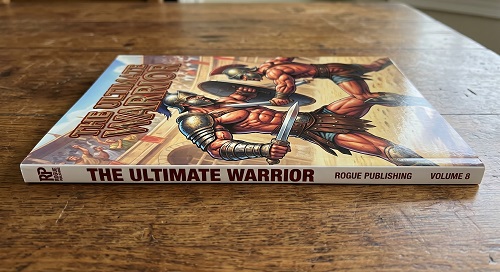
Comic books longer than 32 pages are less common for
standard issues, but they are frequently printed for special releases. Expanded
page counts are often used for:
- Annuals and Special Event Comics
- One-Shot Standalone Stories
- Giant-Size and Oversized Issues
- Anthologies and Collections
- Anniversary Issues
- Graphic Novels
A Quick Note on Binding Thicker Books: Once your comic
exceeds 60 pages, we highly recommend upgrading from saddle-stitching to perfect
binding.
Trying to saddle-stitch too many pages with wire staples can create a bulging effect near the spine that keeps the book from lying flat. Perfect binding solves this by securing the cover and pages together with a strong but flexible adhesive, yielding a very crisp and uniform appearance.
So while
saddle stitch binding is ideal for thinner comics, perfect binding is the go-to
method for thicker books.
Let's Bring Your Comic Book to Life
The page count and binding method not only determine the
appearance and function of your comic books, but they also directly impact your
printing costs. So if you aren't sure whether your project needs a saddle-stitched
format or a perfect-bound spine, the team at Color Vision is here to help.
With decades of experience in digital and offset
comic book printing, we can verify your page count, go over your binding
options, and help you select the perfect paper stock for your budget.
Ready to see how much your comic will cost to print? Use our simple Quote Request form to send us your specs and we will provide a custom quote. Or, give our print experts a call at 800-543-6299 to discuss your project by phone. We look forward to bringing your comic to life!

Pete is a member of the Color Vision team and has nearly 20 years experience in printing, design, and marketing. He writes about a wide range of print-related topics, including book printing and binding, full-color printing, paper types, and finishing techniques. His articles contain simple, straightforward explanations, helping people to better understand their printing options and make more informed decisions about their projects.
Related Articles
Common Comic Book Printing Mistakes (and How to Avoid Them)
Read This Article
Creating a Comic Book? Here’s some Advice from a Printer
Read This Article
Custom Comic Book Printing: 10 Frequently Asked Questions
Read This Article
Comic Book Binding: Exploring the Two Most Popular Methods
Read This Article