
Commercial Book Printing: What are my Paper Options?
estimated reading time: 6 minutes
What Paper should I use to Print my Books?
Choosing the right paper is one of the most important
decisions you'll make when having books printed. The paper not only affects how
your books will look and feel, it also affects the readability and durability
of the books.
Commercial printers typically offer a variety of paper
options for the pages and covers of books, each of which is suited for a particular
purpose. So whether you're planning to print a novel, manual, textbook,
marketing publication or any other type of book, understanding the available options
will help you decide which type of paper best supports your book's intended
use.
Below is a breakdown of the most common paper choices you
will likely encounter as you prepare to have your books printed…

Coated Paper vs Uncoated Paper
In commercial printing, coated paper and uncoated paper are
two of the most prevalent paper types.
The key distinction lies in whether a surface coating was
applied at the paper mill, which directly influences the paper's sheen level, feel,
and overall printing performance.
Coated paper has a thin surface layer (usually clay, polymers, pigments, or similar materials) applied during manufacturing. This coating seals the paper fibers, creating a smoother, less porous surface.
Also, the coating can
be applied to one side or both sides of a paper sheet.
Coatings give paper a smoother finish and help to moderate
the amount of ink that is absorbed. The more coating that is applied, the shinier
the finish and the more vivid the ink colors will appear when printed.
For example, a gloss coating penetrates and fills the paper
fibers more completely than a matte coating. As a result, gloss coatings
deliver the highest level of image sharpness and color vibrancy, while matte
coatings produce softer visuals with more subdued colors.
Coated paper is better suited for books containing color-rich
images or design-heavy layouts, such as product catalogs, magazines, cookbooks,
children's picture books, coffee table books, or illustrated instruction manuals.
Coated paper is also a better choice than uncoated paper for
the covers of books. In addition to providing a smoother and more professional
appearance, coated stocks offer some resistance to scuffs, dirt, and moisture.
Uncoated Paper does not receive a surface coating at the
paper mill. This leaves the paper fibers exposed, resulting in paper that has a
rougher texture and is more porous.
Uncoated paper maintains its natural, textured feel. Ink
easily absorbs into the paper fibers, giving the book's content a softer
appearance. Because uncoated paper has no sheen, it is not prone to glare. This
allows for improved readability in all light conditions. The printed content will
not only be more comfortable for the eyes, the rougher texture of uncoated
paper provides some "grip" for easier page turning.
These qualities make uncoated paper the preferred choice for
books where readability and a natural feel are more important than high-impact
color reproduction. This includes novels, biographies, manuals, textbooks,
reference guides, poetry collections, and other text-heavy books.
Plus, because the absorbent surface can capture ink and
pencil marks better than coated stocks, uncoated stocks are also recommended for
workbooks, journals, planners, notebooks, activity books, and any other books
that need a writable surface that won't smudge or smear.
Paper Weight Choices
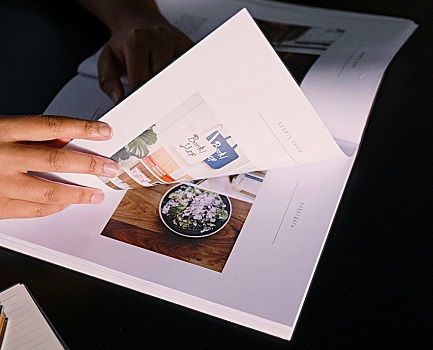
Most commercial printers offer a multitude of different paper thicknesses
for the interior pages and covers of books, each of which is suited to specific needs.
In the US, the thickness of a paper stock is often referred
to as its "weight." The weight of text stocks are typically specified in pounds,
with is abbreviated as lb or #. In any given paper category, a heavier pound
weight means thicker paper.
Whereas the paper for a book's interior pages must be
flexible enough to turn easily, a book's cover paper is typically thicker and
sturdier to boost the book's durability, visual appeal, and overall value.
Known as cover weights or cardstocks, the thickness of these
heavier papers is sometimes specified in pounds but is more likely to be referred to as
points, which is often abbreviated as pt. One point is equal to one thousandth
of an inch or .001".
Common Paper Options for the Interior Pages of Books:
50 lb text: Lightweight and economical, often used for books with high page counts to keep the overall book thickness manageable or for
books that are expected to see limited use.
60 - 70 lb text: A popular choice that works well for the
majority of book projects.
80 - 100 lb text: Thicker and more durable paper, used when
a premium feel and/or increased opacity matter more than keeping the book light
in weight or low in cost.
Common Paper Options for the Covers of Books:
80 - 100 lb cover: The lighter end of the cover weights but still fairly durable, commonly used for the covers of saddle-stitched
books.
10 - 12 pt cardstock: A very popular choice for the covers of perfect bound
books.
14 - 16 pt cardstock: A thicker and more rigid stock for
premium perfect bound books as well as spiral coil bound or wire-o bound books.
Paper Color Options
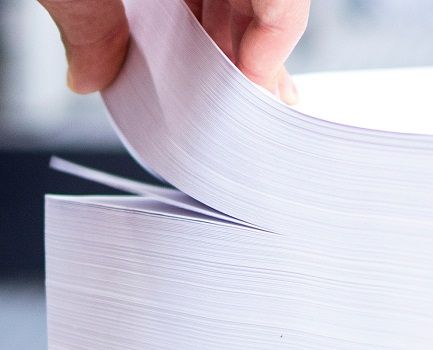
There are hundreds of different paper colors available in
today's market. However, only a select few are truly suitable for book
printing. This is because readability is the primary concern of printed books,
and only a limited number of paper colors offer the proper level of contrast
between the ink and the sheet.
In addition, commercial printing presses are optimized for the
industry's standard ink colors, with black ink being the most common individual
color and the four CMYK inks being the most common color system. Using dark or
unusual paper colors would alter the appearance and contrast of the printed text
and images, thus making these stocks unsuitable for book production.
Having said all that, the most practical paper colors for
the pages of books are White, Off-White, and Cream.
White paper (sometimes called Bright White to distinguish it from Off-White) is by far the most popular choice for
printed books. It is also the most widely available paper color and thus the
most cost-effective. White paper is available as a coated or uncoated
stock.
White paper offers the highest contrast for text and
images. It also ensures accurate color reproduction, which is especially
beneficial for books that contain lots of pictures or illustrations.
Off-White paper (also known as natural white, soft white, or
warm white) has a softer, ivory-like tone. Its subtle tint sits between White and Cream. Off-White paper is available primarily as an uncoated stock,
but some thicknesses of Off-White paper are available as coated.
Off-White paper reduces the ink contrast slightly, but many
readers find this to be easier on the eyes during longer reading sessions. As
such, Off-White paper is a good fit for text-heavy books like novels, memoirs,
and literary nonfiction books.
Cream paper is generally defined as having subtle yellow or
beige undertones. Of the three paper colors mentioned here, Cream is the
warmest shade.
Like Off-White paper, Cream paper reduces the ink contrast
to some extent. This is beneficial to many readers because it reduces eye
fatigue. Since Cream paper is intended mostly for interior pages printed in
black ink, it is available mainly as an uncoated stock.
Cream paper is often used to give books a classic, more
traditional quality. Hence, it is often used for books of poetry, literary
nonfiction, and genre fiction such as fantasy, romance, or sci-fi.
Color Vision is Your Trusted Partner for Commercial Book Printing!
If you've been reading up to this point, you have likely
realized there is no single "best" paper for commercial book printing…there is
only the best paper for your specific project.
So whatever type of book you are planning to have printed, it
is important to select paper stocks that provide the properties necessary to
achieve your desired outcome.
If you need some guidance in this regard, Color Vision will
be happy to help you select the best paper for your specific needs. Just give
us a call at 800-543-6299 to discuss your project.
Or, if you already know your specs and are looking for a
cost estimate, simply fill out our Quote Request form and we will be happy
to email a custom quote to you.
Color Vision has been offering commercial book printing
services for over four decades. We have a strong reputation in the industry for
producing high-quality book printing at affordable rates. We urge you to get a
price quote so you can see for yourself.
As always, we hope to hear from you soon and look forward to working with you!

Pete is a member of the Color Vision team and has nearly 20 years experience in printing, design, and marketing. He writes about a wide range of print-related topics, including book printing and binding, full-color printing, paper types, and finishing techniques. His articles contain simple, straightforward explanations, helping people to better understand their printing options and make more informed decisions about their projects.
Related Articles
10 Frequently Asked Questions about Spiral Binding
Read This Article

The 5 Most Affordable Types of Book Binding
Read This Article
10 Frequently Asked Questions about Saddle Stitching
Read This Article
Book Printing: Helpful Advice for Page Numbering
Read This Article