
What Does It Cost to Print a Book? A Realistic Breakdown
estimated reading time: 6 minutes
Understanding the Costs Associated with Book Printing
If you are exploring how much it will cost to produce your book
project, the most frustrating answer you will hear is "it depends."
While it's true that every custom print job has different variables that affect
its cost, you shouldn't have to guess whether your project will cost $500 or $5,000.
To give you an honest look at what books actually cost to
produce, here are examples from recent jobs we have quoted, including the
specific options that affect these numbers.
Real-World Printing Examples: What Customers Actually Pay in 2026
The easiest way to get a feel for book printing costs is to compare
examples of real production specs:
| Project Type | Quantity | Specifications | Binding | Total Cost | Per Book |
|---|---|---|---|---|---|
| Handbook | 1,500 | 5.5" x 8.5", 42 pages Interior: Full-color (4/4) on 60# offset Cover: Full-color (4/4) on 120# matte cover |
Perfect Binding (PUR glue) |
$2,700 | $1.80 |
| Technical Guide | 750 | 8.5" x 11", 56 pages Interior: Full-color (4/4) on 80# gloss text Cover: Full-color (4/4) on 80# gloss cover |
Saddle Stitch (wire staples) |
$2,825 | $3.77 |
| Novel | 500 | 6" x 9", 380 pages Interior: Black (1/1) on 60# cream Cover: Full-color (4/0) on 80# matte cover |
Perfect Binding (PUR glue) |
$4,630 | $9.26 |
| Magazine | 1,800 | 8.5" x 11", 64 pages Interior: Full-color (4/4) on 80# gloss text Cover: Full-color (4/4) on 80# gloss cover |
Saddle Stitch (wire staples) |
$6.660 | $3.70 |
| Comic Book (with 5 variant covers) |
1,730 | 7" x 11", 80 pages Interior: Full-color (4/4) on 80# satin text Cover: Full-color (4/4) on 100# silk cover with matte laminate |
Perfect Binding (PUR glue) |
$6,744 | $3.90 |
| Operation Manual | 225 | 8.5" x 11", 68 pages Interior: Full-color (4/4) on 80# matte text Cover: Full-color (4/0) on 14pt C1S |
Saddle Stitch (wire staples) |
$1,115 | $4.96 |
We periodically update this table with actual jobs we've
quoted to provide accurate, current benchmarks rather than a locked-in price
list. The pricing shown reflects the production costs of printing and binding -
it does not include variables such as shipping or graphics work. Because paper
mill rates, raw material costs, and press requirements vary with market
conditions and your exact file specs, every custom project is quoted
individually.
The Main Variables That Dictate Your Book's Cost
As you can see in the table above, a variety of factors
determine the cost of a book. Here are the specifications that have the biggest
effect on your final invoice:
1. Order Quantity
Because order quantity affects your unit cost more than
any other factor, we always match your project to the type of printing press
that can produce it most economically.
As a general rule, we run order quantities of 1000 or less
on one of our Xerox digital presses. Because there are little to no upfront
setup costs when printing digitally, this keeps your overall investment low for
small to mid-size production runs.
For orders greater than 1000 books, we typically produce
these on one of our Shinohara offset presses. Offset printing consistently yields
the best price for longer runs. While offset setup takes longer, the per-book
price drops quickly as quantities climb.
(For a deeper look at equipment, check out our guide on Digital
Printing vs Offset Printing).
If you're ever unsure how many books to order, you can
always ask us for a quote on multiple quantities, such as 100-200-300 or
500-1000-2000. This will allow you to compare a few quantity options side-by-side
to see how your cost per book changes.
2. Page Count
A book's page count heavily influences the overall cost, as
extra pages require more paper, ink, and production time.
Every sheet of paper bound into a book has two sides. Each
side counts as one page, so there will always be twice as many pages in a book
as there are sheets.
For Perfect Bound, Spiral Coil, and Wire-O bound books,
Color Vision doesn't print pages in traditional signatures, so we only require
that the interior page count be a multiple of two. For Saddle-Stitched books,
the page count must be a multiple of 4. This is because the printed sheets are
folded in half to form the book's spine and every folded sheet produces four
pages of the book.
3. Trim Size
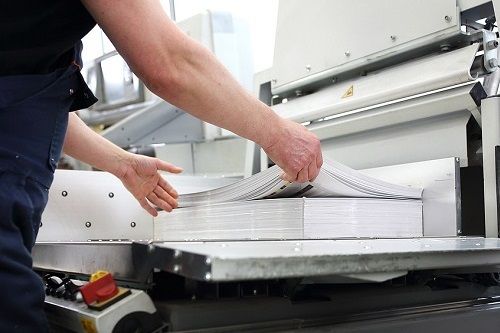
The trim size refers to the final width and height of the
pages after the printed sheets have been cut down to their finished dimensions.
Standard trim sizes yield the best price because they cut
cleanly from stock-size parent sheets with minimal paper waste:
- The most cost-effective standard sizes: 5.5" x
8.5", 6" x 9", and 8.5" x 11"
- Custom sizes: Color Vision can produce your books in virtually any size or format. Because unique dimensions affect how efficiently we can utilize a parent sheet, they typically cost a little more, though we're always happy to help you tweak your specs for the best value.
4. Binding Style
The binding method you choose impacts the book's durability,
aesthetics, and ease of handling:
- Saddle Stitch (stapled): The most budget-friendly method,
but limited to thinner books. An ideal fit for books with 60 pages or
less.
- Perfect Binding (adhesive bound): The square-spine standard
for bookstore-style paperbacks; clean, professional, and economical across both
short and long runs. Because of its superior strength and flexibility, Color
Vision uses PUR glue for perfect binding,
- Spiral Coil or Wire-O: These are the preferred binding
choices for books that need to open fully and lie flat. Slightly higher in cost
because of the multi-step binding process (collating, punching, inserting, and
crimping).
- Hardcover: The most durable and premium look, but commands the highest unit cost due to its lengthier production process.
5. Color vs. Black Ink
- Pages printed in Black Ink: The most economical choice, popular
for novels, poetry, memoirs, trade manuals, and certain genres of comic books.
- Pages printed in Full Color: Requires multi-pass CMYK
imaging across every page, which increases ink and run charges.
6. Cover Finishes & Upgrades
To enhance appearance and durability, most book covers are
printed in full color on cardstock (like 10pt or 12pt C1S). Adding a protective
coating to the cover is a popular option, such as an aqueous or UV coating in gloss
or matte. A soft-touch coating can also be applied to give the cover a velvety
feel.
Additionally, a variety of specialty upgrades are
available. Though these deluxe options raise the cost, they can boost the look
and feel of a book immensely.
- Lamination (Gloss, Matte, or Soft-Touch): A layer of plastic
film is bonded over the cover to offer resistance to scuffs and moisture. A
gloss laminate makes the underlying ink colors more vibrant, while matte and
soft touch laminates soften the ink colors.
- Specialty Embellishments: Options such spot UV, metallic foil stamping, embossing, and die cutting can provide a sense of luxury or craftsmanship before a reader even opens the book. Because most embellishments involve extra setup steps and tooling charges, they are better suited for mid-to-large press runs.
Get a Realistic Quote for Your Project
Because every custom book order has its own unique blend of
dimensions, paper stocks, and finishing steps, the most reliable price is one
calculated for the exact specs of your project.
Color Vision has been printing books since 1984. With both
digital and offset equipment in-house, we run your books on the press that
delivers the best price for your specific quantity and features.
Get exact numbers: Fill out our quick Quote Request form with your page count, size, and other specs.
Speak to an expert: Call our team directly at 800-543-6299 to discuss papers, binding options, or the best way to submit your artwork files.

Pete is a member of the Color Vision team and has nearly 20 years experience in printing, design, and marketing. He writes about a wide range of print-related topics, including book printing and binding, full-color printing, paper types, and finishing techniques. His articles contain simple, straightforward explanations, helping people to better understand their printing options and make more informed decisions about their projects.
Related Articles

Is Wire-O Binding a Good Fit for your Custom Book Project?
Read This Article

Book Printing Costs: How Order Quantity Affects the Price
Read This Article

Pocket Size Book Printing: 9 Ways to Improve your Small Book
Read This Article

10 Ways to Reduce Printing Costs for Instruction Booklets
Read This Article